






















Thousands of residents in Southern California were allowed to return home Monday after officials said the danger of a catastrophic explosion at a chemical storage facility in Garden Grove had been significantly reduced.
Emergency crews spent several days working to stabilize an overheating tank containing hazardous chemicals at an aerospace facility, preventing what authorities warned could have become one of the worst industrial disasters in California history.
Officials Say Worst-Case Explosion Scenario Avoided
Authorities confirmed that the immediate threat of a massive “boiling liquid expanding vapor explosion,” commonly known as a BLEVE, had been eliminated.
The incident centered around a 7,000-gallon tank holding methyl methacrylate, a highly flammable chemical used in the production of plastics and resins.
According to Orange County fire officials, the tank began overheating after a malfunction in the refrigeration system caused temperatures to rise uncontrollably.
Interim Orange County Fire Chief TJ McGovern said emergency responders successfully prevented the most dangerous outcome but cautioned that smaller risks still remain.
Officials noted that there is still limited concern over a possible fire, minor explosion, or chemical spill at the site.
Evacuation Orders Reduced Significantly
At the height of the emergency, roughly 60,000 residents were ordered to evacuate parts of Garden Grove and surrounding areas.
By Monday evening, evacuation orders had been reduced to approximately 16,000 residents as conditions improved.
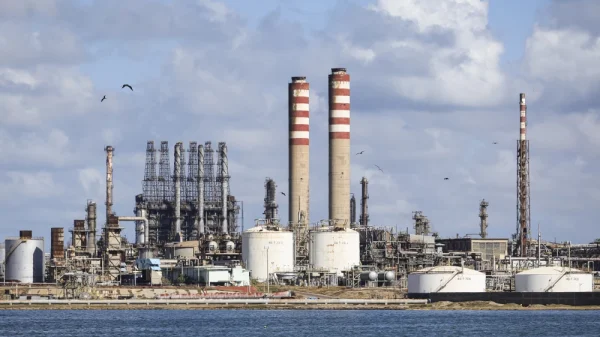
The chemical facility involved in the incident is operated by GKN Aerospace and is located about 35 miles southeast of Los Angeles and just a few miles from Disneyland in Anaheim.
Authorities said remaining evacuation zones would continue to be reassessed as crews monitor conditions overnight.
Cooling Efforts Prevented Disaster
Emergency teams used millions of gallons of water to cool the tank and lower internal temperatures after the refrigeration failure.
Officials explained that a frozen valve in the recirculating cooling system prevented the chemical from staying at its required storage temperature, triggering the dangerous heat buildup.
At one point, the tank temperature exceeded 100 degrees Fahrenheit — the maximum reading available on monitoring equipment. By Monday, temperatures had reportedly dropped to safer levels.
A controlled crack in the tank also helped relieve pressure without causing a leak, allowing crews to remove insulation from the tank and improve cooling efforts.

No Injuries or Environmental Contamination Reported
Authorities confirmed that no injuries have been reported during the emergency response.
Environmental monitoring teams from the Environmental Protection Agency stated that air quality tests conducted throughout the incident detected no dangerous contamination levels in nearby communities.
Officials deployed thousands of air-monitoring instruments across the area to ensure public safety.
Residents Urged to Follow Safety Orders
Local authorities continued urging residents in restricted zones to comply with evacuation instructions until the remaining risks are fully resolved.
Amir El-Farra emphasized that public safety remains the top priority as emergency crews continue working around the clock at the site.
The incident has drawn national attention because of the potentially devastating consequences a major chemical explosion could have caused in densely populated communities near Los Angeles.
Investigators are expected to review the refrigeration system failure and determine what caused the dangerous malfunction once the emergency phase ends.