


















The U.S. Supreme Court has struck down decades-old federal restrictions limiting how much national political party committees can spend in coordination with individual candidates, ruling that the spending caps violate constitutional protections for free speech.
The decision, delivered in a 6-3 majority ruling, marks another significant development in U.S. campaign finance law and is expected to reshape how political parties support candidates in future federal elections.
Court Says Spending Limits Violate Free Speech
Writing for the majority, Justice Brett Kavanaugh concluded that restrictions on coordinated campaign spending infringe upon First Amendment rights. The ruling reaffirmed the court’s long-held position that political spending is a protected form of political expression under the U.S. Constitution.
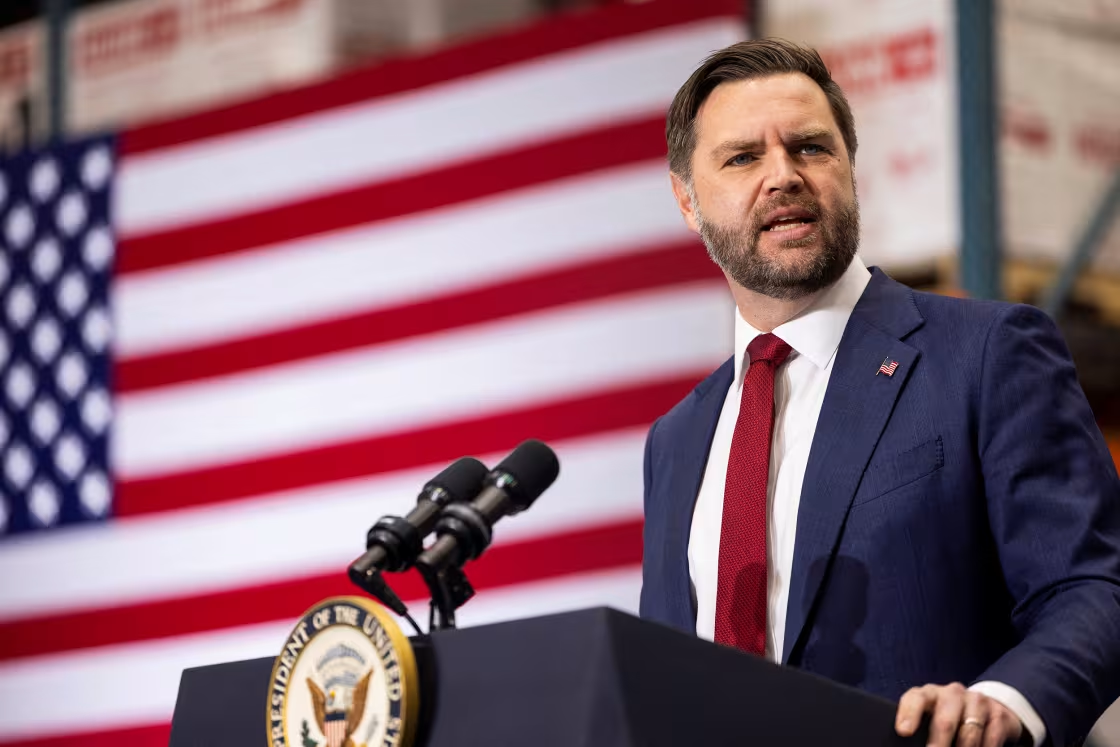
The case was brought by the National Republican Senatorial Committee (NRSC), the National Republican Congressional Committee (NRCC), and the 2022 election campaigns of Vice President JD Vance—then a Republican candidate for the U.S. Senate in Ohio—and former Congressman Steve Chabot.
The Federal Election Commission supported the challenge during the Trump administration.
Decision Expands Political Parties’ Financial Role
The now-invalidated law had allowed political parties to spend unlimited amounts independently in support of candidates but imposed strict limits on spending coordinated directly with campaign organizations.
Coordinated expenditures include campaign-related expenses such as organizing fundraising events, covering candidate travel costs, securing venues, hiring consultants, and other activities carried out jointly with a candidate’s campaign.
Previously, spending limits varied depending on the type of election and the size of the voting population, with Senate races permitted substantially higher coordinated spending than House contests.
Following the ruling, national political parties will no longer face those federal spending caps when working directly with their candidates.
Republicans Welcome the Ruling
Republican leaders praised the Supreme Court’s decision, describing it as a victory for political speech and constitutional rights.
Officials leading the Republican Party’s congressional campaign committees said the judgment confirms that the federal government cannot impose what they characterized as unnecessary restrictions on how political parties support their nominees.
They added that the ruling would allow Republican organizations to provide stronger financial and operational support to candidates in upcoming election cycles.
Democrats Raise Concerns Over Campaign Finance
Democratic Party leaders sharply criticized the decision, warning that eliminating coordinated spending limits could increase the influence of wealthy donors and organized special interests in federal elections.
Party officials argued the ruling weakens safeguards designed to prevent excessive political influence and could further accelerate the growth of campaign spending in the United States.
They also accused Republicans of seeking broader changes to campaign finance regulations that benefit well-funded political organizations.

Another Landmark Shift in Campaign Finance Law
The ruling continues a series of Supreme Court decisions that have gradually reduced federal restrictions on political spending over the past two decades.
Legal experts say the decision builds on previous precedents recognizing campaign expenditures as protected political speech, including the landmark Citizens United v. Federal Election Commission ruling, which significantly expanded the role of outside spending groups in American elections.
Analysts expect Tuesday’s decision to increase coordination between political parties and federal candidates, potentially reshaping campaign strategies ahead of future congressional and presidential elections.