
























China’s economy expanded at an annual rate of 4.3% during the second quarter of 2026, marking its slowest pace of growth since late 2022, according to official data released on Wednesday.
The latest figures represent a significant slowdown from the 5% growth recorded in the January-March quarter and came in below market expectations, highlighting continued challenges in the world’s second-largest economy despite strong export performance.
Exports Remain Strong Despite Global Uncertainty
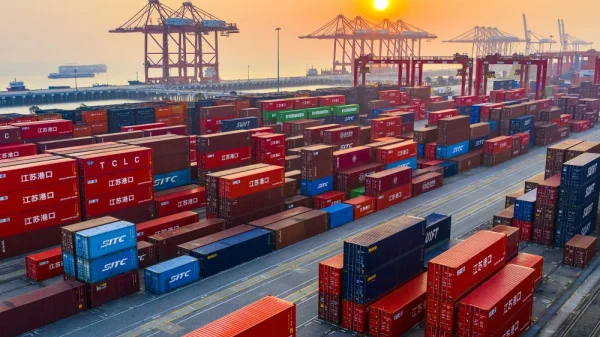
China’s export sector continued to deliver robust results during the first half of the year, supported by rising global demand for advanced technology products, artificial intelligence-related equipment, semiconductors, and electric vehicles.
Customs data showed exports increased 17.6% year-over-year during the first six months of 2026, while June exports alone climbed 27%, reflecting strong overseas demand for Chinese manufactured goods.
The country’s export resilience has helped cushion the broader economy from global disruptions, including higher energy prices linked to ongoing geopolitical tensions in the Middle East.
Weak Consumer Spending Weighs on Recovery
Despite the strength of overseas trade, domestic consumption and private investment remained subdued, limiting overall economic momentum.
Chinese households have continued to reduce discretionary spending as concerns over employment, wage growth, and the prolonged downturn in the property market weigh on consumer confidence.
Economists say the imbalance between export-driven manufacturing and weaker domestic demand remains one of China’s biggest economic challenges.
High-Tech Industries Drive Growth
Government-backed investment in advanced technologies continues to reshape China’s economy, with sectors such as artificial intelligence, robotics, semiconductor manufacturing, and electric vehicles receiving significant policy support.
These industries have experienced rapid expansion, reinforcing China’s position as a major global supplier of high-tech products.
However, analysts warn that the concentration of investment in strategic industries has left traditional manufacturing sectors and labor-intensive service industries growing more slowly, raising concerns about long-term employment opportunities.
The rapid adoption of artificial intelligence and automation has also fueled debate over future job creation as businesses increasingly rely on advanced technologies.
Trade Surplus Continues to Expand
China maintained one of the world’s largest trade surpluses, following a record $1.2 trillion global trade surplus last year.
Several trading partners have continued to criticize Beijing’s industrial policies, arguing that substantial government subsidies have contributed to excess manufacturing capacity and increased exports, affecting competition in international markets.
Chinese officials have defended their economic strategy, emphasizing technological innovation and industrial modernization as key drivers of long-term growth.

Government Acknowledges Economic Challenges
Mao Shengyong, deputy head of China’s National Bureau of Statistics, acknowledged that while production remains strong, domestic demand continues to lag behind.
He said authorities are working to strengthen consumer spending, stabilize employment, and expand the domestic market while maintaining a focus on higher-quality economic development.
Investment experts also noted that China’s economy is undergoing a major structural transition as policymakers shift from traditional growth drivers toward innovation-led industries.
Growth Outlook Remains Moderate
China has set an official economic growth target of 4.5% to 5% for 2026, slightly lower than last year’s target.
The International Monetary Fund recently raised its forecast for China’s economic growth this year to 4.6%, citing resilient exports and policy support. However, the IMF expects growth to slow further to 4.1% in 2027 as structural challenges continue to weigh on the economy.
Economists believe stronger domestic consumption, improved business confidence, and continued policy reforms will be critical if China is to maintain stable long-term economic growth.