

















President Donald Trump’s renewed push to “own” Greenland has ignited international debate, with experts citing both security concerns and the island’s vast mineral wealth as key motivations. Trump frames the move as a matter of national security, aimed at strengthening U.S. control in the Arctic and countering potential threats from Russia and China.
For Greenlanders and European allies, however, the prospect of a U.S. takeover threatens to disrupt decades of Western defense cooperation. Aaja Chemnitz, one of Greenland’s two representatives in the Danish parliament, called the idea “appalling,” emphasizing that a nation cannot simply be bought. Concerns are widespread among the island’s 57,000 residents, nearly 90% of whom are Indigenous Inuit.
European leaders have expressed alarm. French President Emmanuel Macron accused the U.S. of abandoning established international norms, while German President Frank-Walter Steinmeier warned of a “den of robbers” mentality if territorial integrity is ignored.
Greenland, roughly the size of Alaska and California combined, has been under Danish control for centuries. Granted autonomous status in the 1970s, Denmark still manages its military and foreign policy. Historically, the U.S. has maintained a military presence on the island, most notably at the Pituffik Space Base (formerly Thule Air Base), a Cold War-era missile early warning post now operated by the U.S. Space Force.
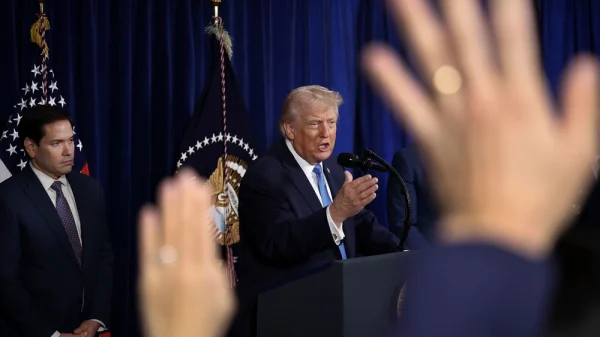
Trump first raised the idea of buying Greenland in 2019, dismissing international criticism as overblown. Recent statements suggest the administration remains serious, with Secretary of State Marco Rubio scheduled to meet Danish and Greenlandic officials to discuss potential deals. The White House has even suggested that military options could be considered, though any unilateral action would strain NATO and challenge international law.
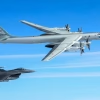
Security is a central argument for Trump’s plan. Greenland lies along the GIUK gap (Greenland, Iceland, United Kingdom), a critical naval passageway for monitoring submarine and maritime movements into the Atlantic. Melting Arctic ice is opening new shipping routes, raising concerns over Chinese and Russian influence. U.S. officials, including Vice President JD Vance, cite Denmark’s insufficient investment in Arctic defense infrastructure as a vulnerability.
Mineral wealth is also a factor. Greenland’s ice retreat exposes reserves of critical raw materials essential for technology and defense, including elements used in electric vehicle batteries and advanced military equipment. European and U.S. analysts believe economic and security considerations are intertwined in Washington’s strategy.
Experts suggest Trump’s interest is driven by a combination of strategic, economic, and political factors. William Alberque, former NATO director for arms control and nonproliferation, described Greenland as a “toxic combination” of national security concerns, China-related geopolitical interests, and economic opportunities.
As discussions continue, Greenland’s future remains uncertain. While U.S. claims are largely seen as enforceable due to America’s global power, European allies warn that respecting territorial integrity is essential to maintaining international order.