

























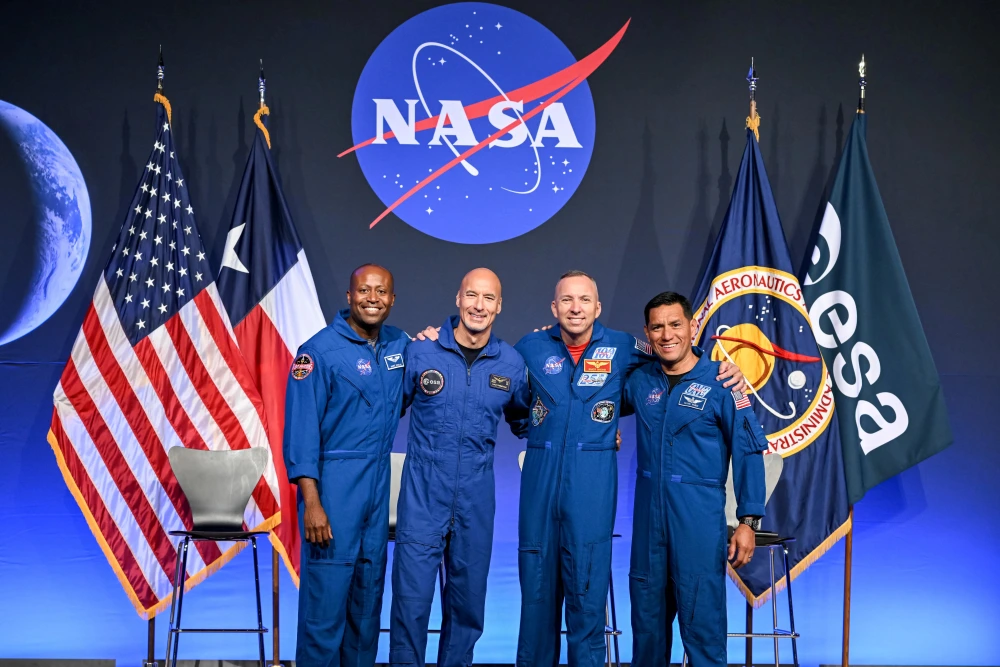
NASA has addressed growing criticism after announcing that its Artemis III test mission crew will not include any women, a decision that triggered widespread debate over representation in the agency’s upcoming lunar exploration program.
The space agency’s explanation comes as it prepares for one of its most complex deep-space missions in decades, aimed at testing key systems for future Moon landings.
Public Reaction Follows Artemis III Crew Announcement
Controversy erupted after NASA revealed the four astronauts chosen for the Artemis III mission, scheduled for launch no earlier than 2027. The crew includes NASA astronauts Randy Bresnik, Frank Rubio, and Andre Douglas, along with European Space Agency astronaut Luca Parmitano.
Following the announcement, critics questioned the absence of female astronauts, with social media users and space enthusiasts expressing disappointment and concern over representation in a historic mission that precedes humanity’s return to the lunar surface.
NASA Defends Selection Process
NASA Administrator Jared Isaacman responded to the criticism, saying the agency had received “reactions ranging from disappointment to outrage” but emphasizing that the selection process is based strictly on mission requirements and astronaut readiness.
According to Isaacman, crew assignments are determined by operational needs, including technical expertise, availability, prior training, and mission-specific experience. He stressed that assignments are not influenced by political appointees and are focused on maximizing the mission’s chances of success.
Strategic Planning Behind Crew Assignments
NASA explained that some astronauts may be assigned to other missions or future Artemis flights based on training cycles and operational scheduling. The agency suggested that experienced astronauts—both male and female—are being distributed across multiple upcoming missions in preparation for a series of increasingly complex lunar operations.
NASA currently has a strong pool of female astronauts, with 15 women among its 37 active astronauts eligible for flight assignments. The agency also noted that its most recent astronaut candidate class included a majority of women, marking a historic milestone in recruitment.
Mission Designed as Key Lunar Landing Test
The Artemis III mission is not a lunar landing itself but a critical orbital test flight designed to evaluate docking procedures between NASA’s Orion spacecraft and commercially developed lunar landers.
The mission will test systems developed by private partners, including SpaceX and Blue Origin, both of which are building spacecraft intended to transport astronauts to and from the Moon under NASA’s Artemis program.
During the roughly two-week mission in Earth orbit, astronauts will practice rendezvous and docking operations that are essential for future lunar surface missions planned under Artemis IV and beyond.
Broader Debate Over Representation in Space Exploration
The announcement has reignited discussions about diversity in space exploration, particularly after NASA previously stated ambitions to land the first woman and the first person of color on the Moon under the Artemis program. That language was later removed from some official communications, prompting further public debate.
Critics argue that the all-male Artemis III crew may undermine those earlier commitments, while supporters of NASA’s decision emphasize that crew selection is driven by technical readiness rather than demographic targets.
NASA Stands by Its Astronaut Corps
NASA reiterated that its astronaut corps includes highly qualified candidates of all genders and backgrounds, and that future Artemis missions are expected to feature different crew compositions as the program progresses.
As Artemis III moves toward its planned 2027 launch window, the agency maintains that the mission is a stepping stone toward sustained lunar exploration and eventual crewed landings on the Moon.