





















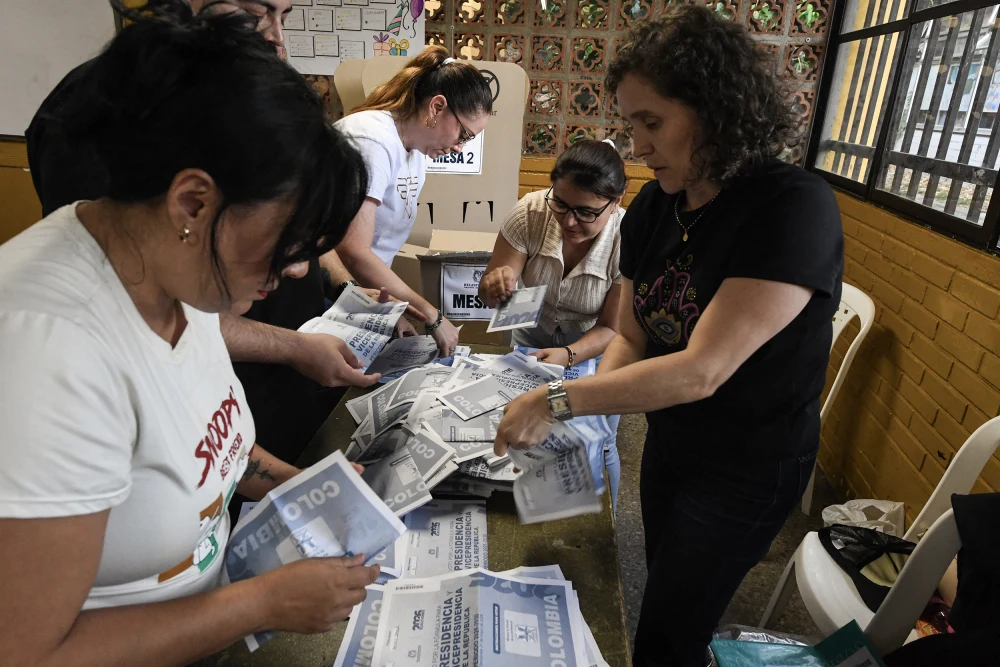
Political tensions in Colombia escalated after outgoing President Gustavo Petro cast doubt on preliminary election results showing his preferred candidate heading into a presidential runoff against a conservative rival with strong backing from right-wing allies in the United States.
The disputed first-round vote placed leftist senator Iván Cepeda in second position, narrowly behind right-wing candidate Abelardo de la Espriella, setting up a runoff election scheduled for June 21.
Tight First Round Sets Stage for Runoff
With nearly all ballots counted, de la Espriella led the race with just over 43% of the vote, while Cepeda followed closely with around 40%. Because no candidate secured an outright majority, the election will move to a decisive second round.
The contest is shaping up as a high-stakes ideological battle between Petro’s left-wing political movement and a conservative bloc promising a tougher stance on crime and governance.
Petro Questions Preliminary Vote Count
Following the announcement of results, Petro publicly challenged the credibility of the preliminary vote count, arguing that the system used by private contractors to process ballots may have been flawed.
He claimed that discrepancies in the voter database and software irregularities could have affected the outcome, though electoral authorities have rejected suggestions of systemic manipulation.
The National Civil Registry has emphasized that preliminary tallies are not final results and are subject to verification before official certification.
Allegations of Irregularities Spark Debate
Cepeda also raised concerns about potential miscounts, stating that his campaign identified inconsistencies in the vote tally and would seek clarification from electoral officials.
Despite these claims, Colombia’s electoral authorities maintain that their system is highly accurate and has historically produced reliable results in national elections.
Observers from international rights organizations have urged all political actors to respect the integrity of the process and await final certification.
High-Stakes Political Showdown Ahead
The runoff will pit Cepeda, a long-time ally of Petro and a key figure in Colombia’s 2016 peace negotiations, against de la Espriella, a political outsider and lawyer who has built his campaign on promises of aggressive security measures and economic reform.
De la Espriella has positioned himself as a hardline candidate aligned with international conservative movements, while Cepeda represents continuity with Petro’s progressive agenda.
Rising Violence and Political Tensions
The election takes place against a backdrop of renewed violence in parts of the country, despite the historic peace agreement signed with the FARC nearly a decade ago.
Security concerns have intensified during the campaign period, with reports of armed attacks and political violence affecting several regions.
Analysts say the fragile security environment could play a decisive role in voter sentiment ahead of the runoff.

International Attention Grows
The election has also drawn attention from U.S. political figures, with several lawmakers expressing support for de la Espriella and framing the contest as strategically significant for regional stability.
The race is widely viewed as a referendum on Petro’s presidency and Colombia’s broader political direction after years of polarization.
What Comes Next
As Colombia prepares for the final round of voting, both campaigns are expected to intensify outreach efforts in a tightly divided electorate.
With trust in electoral institutions under scrutiny and political rhetoric escalating, the runoff is likely to be one of the most closely watched elections in the region this year.