





















President Donald Trump faces a defining foreign policy decision as diplomatic talks with Iran show little sign of breakthrough, even as U.S. military assets surge into the Middle East.
At the same time, a separate political battle is unfolding at home, with Colorado becoming the latest state to enter an escalating national redistricting fight ahead of future elections.
Iran Talks Stall as Military Pressure Mounts
The White House has positioned significant firepower in the region, including aircraft carriers, fighter jets and air defense systems, amid rising tensions with Tehran. Officials say the buildup ensures readiness should Trump opt for military action.
Indirect talks held in Geneva — with Oman serving as intermediary — produced modest signs of progress but no resolution on core disputes. U.S. envoys, including longtime Trump ally Steve Witkoff and Jared Kushner, met with Iranian Foreign Minister Abbas Araghchi.
Vice President JD Vance acknowledged that major gaps remain, saying Iran has not accepted key American “red lines.”
According to U.S. officials, those red lines include severe limits or a ban on uranium enrichment, restrictions on Iran’s ballistic missile program and an end to support for regional proxy groups.
Iran’s Supreme Leader, Ayatollah Ali Khamenei, has publicly rejected negotiations over missile capabilities, calling them nonnegotiable.
Secretary of State Marco Rubio is scheduled to travel to Israel on Feb. 28 to meet Prime Minister Benjamin Netanyahu for consultations on next steps.
Some Republican lawmakers, including Sen. Lindsey Graham, have urged decisive action, arguing Iran is politically and economically weakened. However, many Democrats warn that military intervention could destabilize the region and endanger U.S. troops.
No final decision has been announced, and officials say diplomacy remains under consideration.
Colorado Joins Intensifying Redistricting Fight
While foreign policy dominates headlines, a significant domestic political battle is unfolding in Colorado.
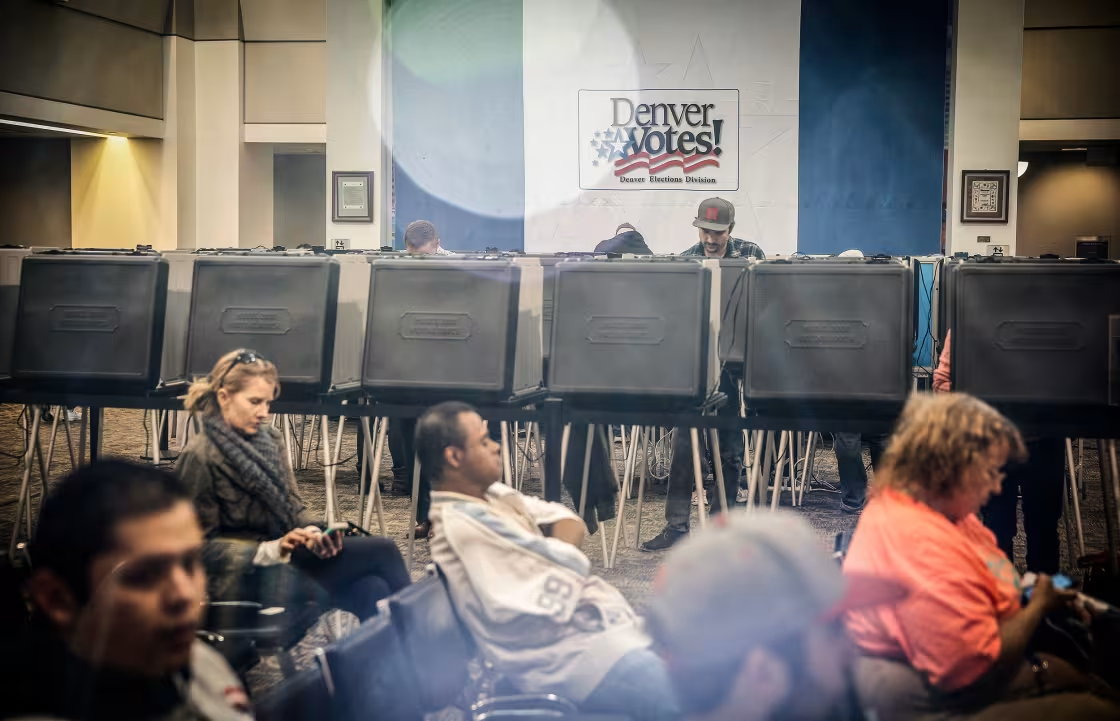
A newly formed group, Coloradans for a Level Playing Field, has launched an effort to place a ballot measure before voters that would temporarily sideline the state’s independent redistricting commission. The proposal would allow Democrats to redraw congressional maps ahead of the 2028 and 2030 elections.
Currently, Colorado’s congressional delegation is evenly split between Democrats and Republicans. The proposed changes aim to create seven Democratic-leaning districts and one Republican-leaning district for the next two election cycles before restoring the independent commission after the 2030 census.
To qualify for the ballot, organizers must gather approximately 125,000 signatures.
Colorado’s move is the latest escalation in a broader mid-decade redistricting battle. Several states have already adopted revised maps ahead of tightly contested midterm elections, with control of the U.S. House of Representatives at stake.

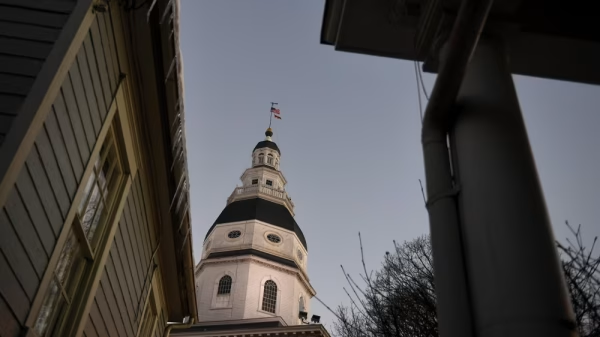
Virginia voters are set to consider redistricting changes in April, while Florida lawmakers are expected to revisit congressional maps during a special legislative session. In Maryland, Democratic leaders continue to debate efforts to eliminate the state’s lone Republican-held district, though internal disagreements have slowed momentum.
High-Stakes Decisions at Home and Abroad
Trump’s pending choice on Iran could reshape U.S. foreign policy and redefine America’s role in the Middle East. Meanwhile, redistricting battles across multiple states signal that partisan competition over House control is far from settled.
Together, the two issues underscore the administration’s simultaneous challenges: navigating international security risks while managing high-stakes domestic political maneuvering.