






















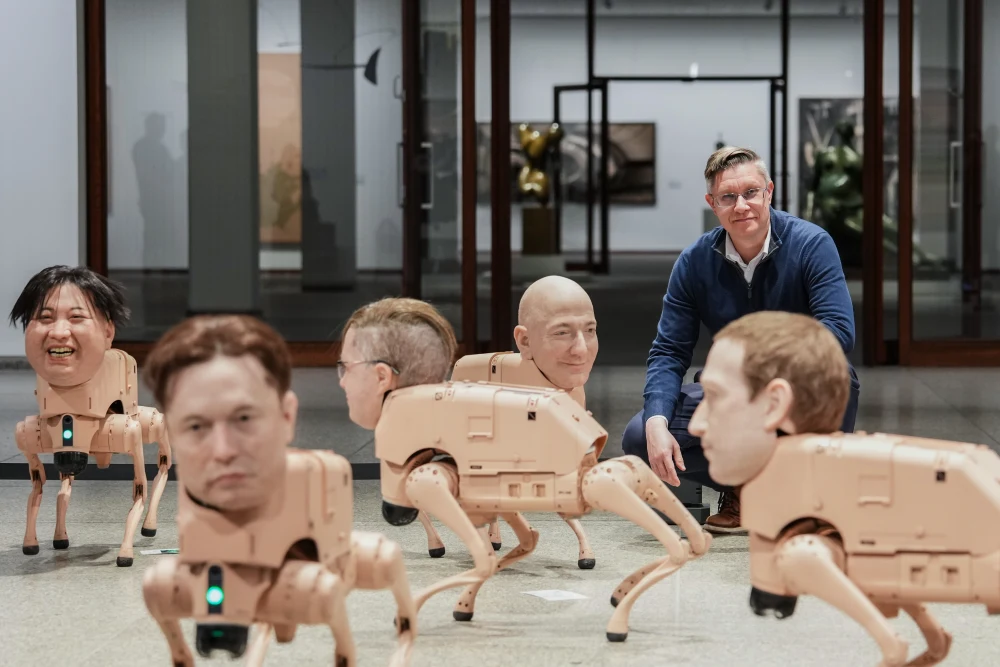
Berlin — A striking new digital art installation by American artist Beeple (Mike Winkelmann) is drawing global attention at Berlin’s Neue Nationalgalerie, where robotic dogs featuring hyper-realistic human faces—including Elon Musk and Mark Zuckerberg—are freely moving through the exhibition space.
The interactive artwork, titled “Regular Animals,” blends robotics, artificial intelligence, and contemporary culture to explore how technology and algorithms influence modern perception and decision-making.
Robot Dogs with Tech Billionaire Faces Steal the Spotlight
At the center of the exhibit are robotic dogs equipped with advanced cameras and silicone human masks modeled after some of the world’s most recognizable figures, including Elon Musk, Mark Zuckerberg, Jeff Bezos, Andy Warhol, Pablo Picasso, and even North Korean leader Kim Jong Un.
The machines roam the gallery autonomously, capturing images of their surroundings and producing printed outputs that reflect their observations. In a surreal twist, the robots occasionally “excrete” printed visuals of what they have seen, reinterpreted through AI filters inspired by the personalities they represent.
Each output reflects a stylized interpretation of reality—for example, the Picasso-inspired robot produces Cubist-like visuals, while the Warhol version generates pop-art-inspired imagery.
Art Reflecting AI and Algorithmic Influence
According to the exhibition’s curators, the installation highlights how artificial intelligence and digital platforms shape human understanding of the world by filtering what people see and how they interpret it.
Beeple explained that the work draws parallels between historical artistic influence and today’s tech-driven information ecosystem.
“In the past, artists shaped how we saw the world,” Beeple said. “Now, that influence has shifted to tech platforms and algorithms controlled by a small number of powerful companies.”
He further noted that modern tech leaders now have unprecedented influence over global perception, often without traditional regulatory oversight.
A Commentary on Power and Perception
The exhibit suggests that today’s digital experience is increasingly shaped by algorithmic systems rather than individual creativity or editorial judgment. Beeple argues that this shift gives technology companies significant, and often invisible, control over public perception.
The robot dogs even include a version modeled after Beeple himself, reinforcing the theme of self-reflection in a digitally constructed world.
Curatorial Perspective and Museum Response
Lisa Botti, curator of the exhibition, described artificial intelligence as one of the most transformative forces of the modern era. She said museums play a critical role in helping society examine these rapid changes.
“The museum is a space for reflection,” Botti said, emphasizing the importance of showcasing works that question the relationship between humans, machines, and information systems.
Beeple’s Rise in Digital Art and NFT Culture
Beeple is widely recognized as a pioneer in digital art and is known for his “Everydays” project, where he created and published a new artwork daily for over 5,000 consecutive days.
He gained global fame in 2021 when his digital collage “Everydays: The First 5000 Days” sold for more than $69 million at Christie’s, making him one of the most valuable living artists in the world.

His work is closely associated with NFTs (non-fungible tokens), blockchain-based digital certificates that verify ownership of digital assets and have significantly influenced the online art market.
From Art Basel to Berlin
“Regular Animals” was previously showcased at Art Basel Miami Beach in 2025 before arriving in Berlin. At earlier exhibitions, Beeple even distributed printed outputs from the robot dogs to visitors, some accompanied by NFTs that allowed recipients to claim ownership or further monetize the digital artwork.