











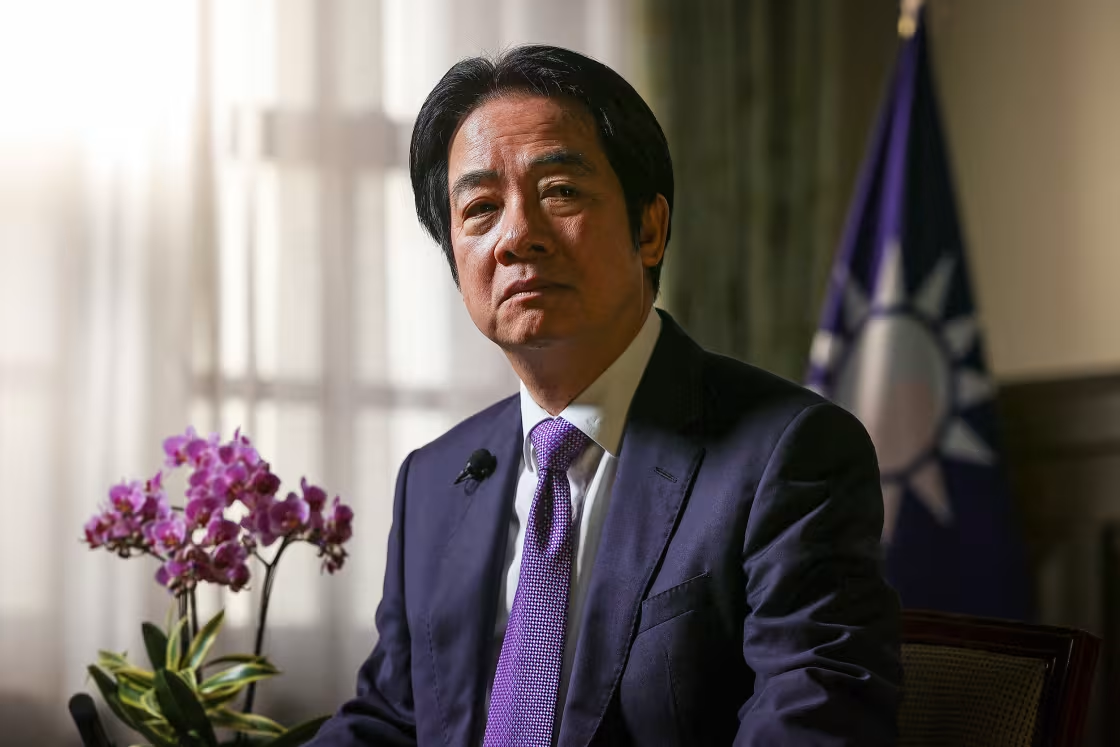
Taiwan has reaffirmed that its future can only be decided by its own people after comments from U.S. President Donald Trump raised fresh uncertainty over Washington’s position on arms sales and potential military support for the island.
The diplomatic exchange comes in the wake of Trump’s recent summit with Chinese President Xi Jinping in Beijing, which has intensified concerns in Taipei about shifting U.S. policy on one of Asia’s most sensitive security flashpoints.
Trump questions arms sales and defense stance
During remarks following the summit, Trump said he had not yet decided whether to proceed with a proposed multibillion-dollar arms package for Taiwan, a self-governing democracy that China claims as its territory.
He also suggested caution about direct U.S. military involvement in a potential conflict over the island, reiterating that he was not eager for American forces to be drawn into a war in the region.
The comments have fueled concern in Taipei, where U.S. arms support and strategic backing are seen as key deterrents against Chinese military pressure.
Taiwan reiterates sovereignty position
In response, Taiwan’s President Lai Ching-te emphasized that only the people of Taiwan have the right to determine their political future.
He said Taiwan operates as a sovereign democratic system and is not subordinate to Beijing, stopping short of directly referencing Trump’s remarks but reinforcing the island’s longstanding position on self-governance.
Taiwan’s foreign ministry echoed that stance, stating that the island remains an independent democratic entity and rejecting any claims of subordination to China.
Rising tensions after Trump-Xi meeting
The statements come after Trump’s meeting with Chinese President Xi Jinping, during which Taiwan reportedly featured as a central point of discussion.
Xi described Taiwan as the most sensitive issue in U.S.-China relations and warned that mishandling the matter could lead to serious consequences, according to Chinese state media reports.
Beijing continues to view Taiwan as part of its territory and has not ruled out the use of force to achieve unification, while maintaining increasing military and political pressure on the island.
U.S. policy remains officially unchanged
Despite political uncertainty, U.S. officials have reiterated that Washington’s long-standing policy toward Taiwan remains in place.
The United States maintains a policy of “strategic ambiguity,” under which it does not explicitly confirm whether it would intervene militarily in a conflict but continues to provide defensive arms to Taiwan.
Taiwan remains the largest recipient of U.S. arms in the region, a key element of deterrence against potential Chinese military action.
Debate over future of U.S. commitments
The remarks have triggered debate in Washington over the future of U.S. defense commitments in Asia. Some lawmakers argue that continued arms support is essential to deter aggression, while others question the risks of deeper involvement in a potential conflict.
Analysts say any perceived shift in U.S. positioning could significantly alter the strategic balance in the Indo-Pacific and influence China’s calculations regarding Taiwan.
A sensitive geopolitical balance
Taiwan remains one of the most volatile issues in global politics, with the island situated just miles from mainland China yet operating as a self-governing democracy with its own political system.
While diplomatic ties between the U.S. and Taiwan are unofficial, Washington remains Taipei’s most important security partner, a relationship that has long drawn criticism from Beijing.
Conclusion
As tensions continue to rise following high-level U.S.-China talks, Taiwan has moved quickly to reaffirm its sovereignty stance while carefully navigating uncertainty over future U.S. support. The evolving rhetoric underscores the fragile balance in one of the world’s most sensitive geopolitical rivalries.