





















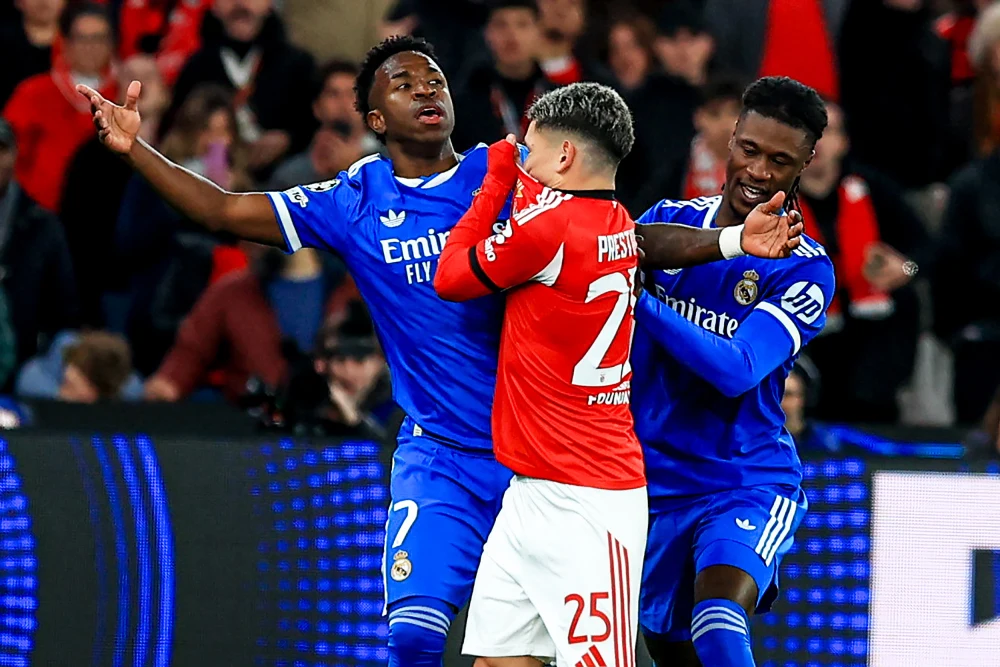
New rule aims to improve transparency in player interactions following controversial Champions League incident involving Vinícius Júnior
Players at the upcoming FIFA World Cup will face red cards if they cover their mouths while engaging in disputes on the pitch, under a newly approved rule designed to prevent concealment of on-field conversations and improve officiating transparency.
The decision was confirmed after a meeting of the International Football Association Board (IFAB), which approved the measure unanimously ahead of the global tournament.
Rule Introduced After High-Profile European Incident
The new regulation follows a widely publicized confrontation during a UEFA Champions League match in February involving Real Madrid forward Vinícius Júnior and Benfica player Gianluca Prestianni.
During the match, Prestianni was seen covering his mouth while speaking to Vinícius Júnior after a goal celebration. The incident escalated when Vinícius reported alleged racist abuse to the referee, triggering an official investigation protocol on the field.
Although no immediate disciplinary action was taken during the match due to insufficient evidence, the episode sparked widespread debate in the football community about hidden communication during disputes.
Stricter Enforcement of On-Field Conduct
Under the new rule, any player who intentionally covers their mouth during an argument or confrontation will be shown a red card. Officials say the measure is intended to ensure referees can clearly assess player behavior and language during tense situations.
A second rule change also introduces red cards for players who leave the pitch in protest of referee decisions.
FIFA and IFAB officials argue that both changes are designed to strengthen accountability and reduce ambiguity in high-pressure match situations.
Racism Allegations and Disciplinary Debate
The February incident gained further attention after Vinícius Júnior alleged that a racial slur had been directed at him. The claim was denied by Prestianni, who later stated he used a different type of offensive language during the exchange.
European football authorities investigated the incident, resulting in a six-match suspension for Prestianni for homophobic discrimination. UEFA distinguishes between disciplinary penalties, with racist abuse carrying a minimum 10-match suspension under its regulations.
The case intensified calls for clearer rules regarding player conduct during disputes, particularly when communication is obscured.
FIFA Leadership Supports Greater Transparency
FIFA President Gianni Infantino has publicly backed stricter enforcement, stating that players should not attempt to hide their words during confrontations.
Officials argue that covering the mouth raises suspicion and complicates investigations into alleged misconduct, particularly in cases involving discrimination or abuse.
Broader Impact on the Game Ahead of World Cup
The rule change is expected to significantly alter how players interact during matches, especially in emotionally charged moments. Analysts say it reflects growing pressure on football governing bodies to address issues of discrimination while maintaining transparency on the field.

As preparations continue for the FIFA World Cup, officials are positioning the updated disciplinary framework as part of a broader effort to modernize refereeing standards and ensure fair play at the sport’s highest level.