





















Florida lawmakers have once again rejected Governor Ron DeSantis’ efforts to introduce state-level artificial intelligence regulation, highlighting a widening divide within the Republican Party over how the rapidly expanding technology should be governed.
The decision comes as DeSantis positions himself as one of the most prominent Republican critics of artificial intelligence, while many GOP leaders at both state and federal levels favor a lighter regulatory approach.
GOP Lawmakers Refuse to Advance AI Bill
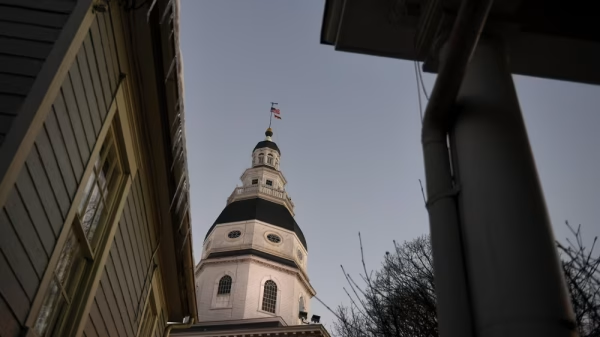
During a special legislative session in Tallahassee, Republican leaders in the Florida House declined to consider an AI-focused regulatory proposal backed by DeSantis. House Speaker Daniel Perez confirmed that the measure would not be taken up, effectively blocking its path forward.
The special session was primarily called to address congressional redistricting, leaving limited political space for additional policy debates. Perez noted that there was no filed House bill supporting the governor’s AI plan, making formal consideration impossible.
The stance aligns closely with the position of President Donald Trump’s administration, which has argued that artificial intelligence regulation should be handled at the federal level rather than by individual states.
DeSantis Pushes State-Level AI Oversight
Governor DeSantis has repeatedly advocated for stricter oversight of artificial intelligence, including limits on large-scale data centers and safeguards aimed at protecting children from potential online harms.
His office has expressed concerns about the rapid expansion of AI tools and their societal impact, warning about risks such as harmful chatbot interactions and data misuse. DeSantis has framed the issue as a broader struggle between state authority and powerful technology companies.
Despite these warnings, Republican lawmakers in Florida have shown little interest in advancing his proposals.
Internal Republican Tensions Emerge
The clash highlights growing divisions within the Republican Party over technology policy. While DeSantis has adopted a more cautious stance toward AI, other influential GOP figures are embracing the industry’s economic potential and advocating for national-level regulation instead of state intervention.
The disagreement also reflects a broader ideological split between state autonomy and federal oversight in emerging technologies.
National Politics Shape AI Debate
Artificial intelligence has become an increasingly important issue in national politics, with tech companies and political action groups investing heavily in shaping policy outcomes ahead of the 2026 midterm elections.
At the federal level, several Republican leaders have voiced support for a unified national framework rather than a patchwork of state laws. This approach is seen as more favorable by major technology firms, which argue that inconsistent state rules could hinder innovation.
DeSantis, however, has carved out a separate position within the party, making AI regulation a key part of his political identity as he continues to build national recognition ahead of the 2028 presidential cycle.
Industry Concerns and Public Debate
The debate over AI regulation has intensified as public concerns grow about job displacement, privacy risks, and the social impact of rapidly evolving technologies.
A recent public opinion survey indicated that a majority of voters are uneasy about the pace of AI development and question whether its risks outweigh its benefits. Many also expressed skepticism about whether either major political party can effectively manage the technology’s expansion.

Experts note that concerns are particularly strong among younger voters and women under 50, especially regarding employment disruption and online safety.
Florida’s Role in the AI Policy Landscape
Florida is increasingly seen as a key battleground in the national debate over artificial intelligence policy. While DeSantis continues to push for tighter state-level controls, Republican leadership in the legislature has aligned more closely with federal regulatory approaches.
The latest rejection of the governor’s proposal underscores how divided policymakers remain over how to balance innovation with oversight in one of the fastest-growing sectors of the global economy.
For now, Florida’s legislature appears unlikely to revisit AI regulation in the immediate future, leaving the issue largely unresolved at the state level.