




















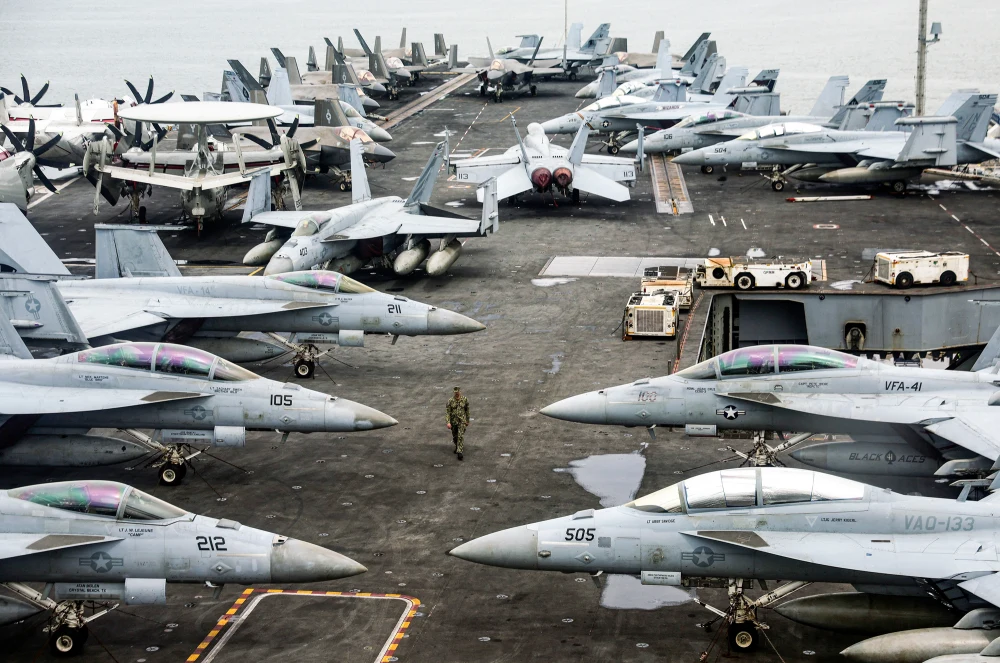
The United States is significantly reinforcing its military footprint across the Middle East, deploying additional warships, air defense systems and submarines as President Donald Trump weighs potential military action against Iran.
The Pentagon’s buildup comes even as Washington and Tehran continue indirect diplomatic negotiations aimed at preventing open conflict. U.S. officials say no final decision has been made on military strikes, but forces are being positioned to ensure rapid response capabilities if talks collapse.
Aircraft Carriers and Naval Forces Move Into Position
Among the most notable deployments is the USS Gerald R. Ford, which is crossing the Atlantic and is expected to enter the Mediterranean Sea in the coming days. It will join the USS Abraham Lincoln and its carrier strike group already operating in the Persian Gulf.
A U.S. nuclear-powered submarine remains stationed in the Mediterranean, while multiple guided missile destroyers and littoral combat ships are operating in the Red Sea and near the Strait of Hormuz, according to defense officials and public ship-tracking data.
The expanded naval presence provides the U.S. with the ability to launch operations from sea-based platforms, reducing reliance on air bases in Arab Gulf states. Several regional governments have expressed reluctance to allow offensive missions from their territory, fearing retaliation from Iran.
Strait of Hormuz Concerns Resurface
Tensions are particularly high around the Strait of Hormuz, a critical global shipping corridor that handles roughly one-fifth of the world’s oil supply. Iranian officials have repeatedly threatened to block the waterway in response to any attack.
This week, Iranian state media reported temporary closures in parts of the strait during military exercises conducted by the Islamic Revolutionary Guard Corps.
Diplomacy Continues Amid Military Preparations
Despite the military positioning, diplomatic efforts remain active. Iranian Foreign Minister Abbas Araghchi described recent indirect talks in Geneva as showing “good progress.” The discussions involve U.S. intermediaries and focus on Iran’s nuclear activities and ballistic missile program.
The Trump administration has insisted that any agreement must include restrictions on both nuclear enrichment and missile development — conditions Tehran has so far resisted.
White House officials confirmed that senior national security advisers met in the Situation Room this week to assess developments. The U.S. is awaiting a written proposal from Iran addressing key areas of disagreement.
Rubio to Brief Israel
Secretary of State Marco Rubio is scheduled to travel to Israel on February 28 to meet Prime Minister Benjamin Netanyahu. Israeli officials remain deeply concerned about the trajectory of negotiations and have urged Washington to ensure that any deal addresses Iran’s missile arsenal and regional proxy networks.
It remains unclear whether any potential U.S. strike would be unilateral or coordinated with Israel.
Military Options Under Review
The current force posture mirrors the U.S. buildup that preceded limited airstrikes on Iranian nuclear facilities last June. That operation, which targeted three sites, marked the first direct U.S. air attack on Iranian territory.
Defense analysts say Washington now has sufficient assets in the region for limited strikes, though a broader campaign aimed at regime change would likely require additional forces.
Potential targets could include:

- Air defense systems
- Ballistic missile launch sites
- Drone manufacturing facilities
- Revolutionary Guard bases
Some experts warn that a prolonged conflict could destabilize the broader Middle East and disrupt global energy markets.
High Stakes for U.S. Policy
President Trump has repeatedly stated that diplomacy remains his preferred option but has also emphasized that Iran must accept strict conditions to avoid further escalation. He has previously suggested that political change within Iran could be a long-term solution.
The coming weeks may prove decisive. If negotiations falter, the U.S. will face critical choices that could reshape regional security dynamics and test American credibility on the global stage.