

























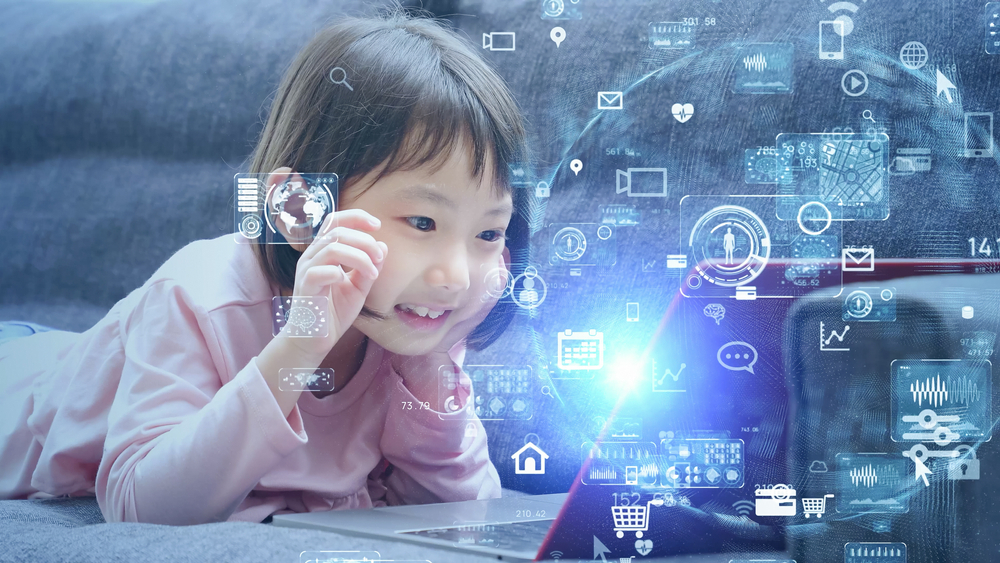
Witnessing a child use AI to instantly solve homework without engaging with the problem itself is a profound moment—one that sparks deep questions about the trajectory of education, cognition, and childhood in the age of artificial intelligence. This scenario, seemingly a small everyday event, may be a harbinger for what the next generation of kids, raised with pervasive AI, will become. What will they look like 10 or 20 years from now? Let’s explore the possibilities—both hopeful and cautionary—in a detailed, engaging examination of a future shaped by AI-infused childhoods.
The Current Moment: AI as an Educational Crutch
Right now, tools like AI homework solvers, instant translators, and digital tutors are becoming increasingly common. Kids can:
Get immediate answers to questions without reading or analyzing.
Use AI to write essays, code, and even generate creative content.
Translate entire passages instantly without language learning.
While these tools promise efficiency and access, they risk reducing the cognitive effort students invest. Children might grow detached from the process of learning, relying on AI for quick results rather than deep understanding.
Imagining 10 Years from Now: Children Raised Alongside AI
Intellectual Development and Learning Habits
Cognitive Shifts: Children who grow up with AI assistants embedded in their daily lives may develop different cognitive skills. Rather than memorization or traditional problem-solving, their brains might excel at:
Critical thinking about AI’s answers: evaluating when to trust the machine.
Real-time information synthesis: integrating AI suggestions with human intuition.
Creativity fueled by AI collaboration, pushing new frontiers in arts and sciences.
However, there is a danger of weaker foundational skills if the habit of checking answers immediately replaces thoughtful engagement—potentially impacting reasoning and attention span.
Emotional and Social Dimensions
Empathy and Interpersonal Skills: If AI intermediates communication—chatbots helping with conversations, AI tutors mediating social learning—kids might:
Develop new forms of social intelligence and digital empathy that blend human and machine cues.
Face challenges in reading unmediated emotional signals, potentially reducing authentic face-to-face social skills.
Children might become more comfortable with AI companions than with other humans, shifting social dynamics dramatically.
Education and Skill Sets
Curriculum and Pedagogy: Schools will likely evolve to emphasize:
AI literacy: understanding algorithms, biases, ethics behind AI tools.
Meta-cognitive skills: teaching students how to question AI output and think independently.
Specialized skills where uniquely human insights or hands-on experiences are irreplaceable.
Traditional homework might transform into collaborative human-AI projects, creative problem design, or fields where AI cannot replicate nuanced judgment.
Ethical and Psychological Challenges
Dependence and Agency: A key concern is the potential overreliance on AI, where children lose confidence in their own judgment or have diminished motivation to learn difficult concepts without AI’s instant help.
Psychologically, children might experience:
Reduced frustration tolerance, as AI removes natural hurdles of trial and error.
Identity issues, questioning whether accomplishments are truly their own or AI-generated.
Broader Societal Impacts
Workforce and Economy
The next generation will enter a workforce where AI has automated many routine tasks. Thus, children will need:
Strong skills in creativity, emotional intelligence, and strategic thinking.
The ability to manage and oversee AI systems rather than just use them passively.
Education will likely focus less on rote knowledge and more on adaptability.
New Forms of Inequality
AI access disparities could widen social divides—kids with better AI tools or guidance might excel, while others fall behind. There will be urgent calls to ensure equitable AI-enhanced education for all.
A Balanced Vision: Harmonizing AI and Human Growth
The future need not be dystopian. Parents, educators, and technologists must collaborate to craft a childhood where AI is an empowering tool, not a crutch. Possible priorities include:

Encouraging curiosity and persistence beyond AI’s easy answers.
Structuring AI tools that prompt children to explain their reasoning.
Cultivating diverse experiences—arts, sports, outdoor play—that AI cannot replicate.
Fostering ethical discussions about AI’s role in society from a young age.
Conclusion: The Children of the AI Era—Who Will They Be?
The children raised by AI will be different, carrying the imprint of this profound technological shift. They could become unprecedentedly capable—thinking and creating with AI as an intuitive extension of their minds. Or, in the absence of mindful guidance, they might face challenges in critical thinking, emotional maturity, and independence.