

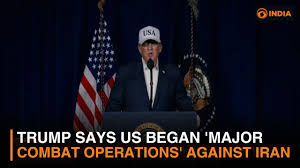















The United States, in coordination with Israel, has launched large-scale military operations against Iran, President Donald Trump announced Saturday in a video address. The strikes targeted Iranian military and security sites, marking the most significant escalation in U.S.-Iran tensions in recent years.
“We sought repeatedly to make a deal. We tried,” Trump stated, referencing ongoing negotiations with Tehran over its nuclear program. “Our objective is to defend the American people by eliminating imminent threats from the Iranian regime.”
Coordinated Air and Sea Operations
U.S. officials confirmed the operation, dubbed Operation Epic Fury, involved both air and sea assaults, deploying fighter jets and other military assets against strategic targets. Efforts were reportedly underway to minimize U.S. casualties, though Trump acknowledged the potential for losses among American forces.
Iran responded almost immediately, launching missiles at U.S. military installations in the region, including the U.S. Fifth Fleet’s service center in Bahrain. Details on casualties have not been released.
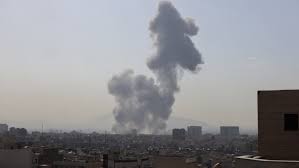
In Tehran, explosions were reported across the city, prompting Iran to close its airspace. Videos released by local media showed smoke rising from multiple locations.
Israel’s Role and Regional Impact
Israel participated in preemptive strikes against Iranian sites, with Prime Minister Benjamin Netanyahu declaring that the joint operation aimed to neutralize what he described as an “existential threat” from Iran. Israeli authorities confirmed missiles had been fired from Iran toward Israel following the initial attacks.
The escalation has raised concerns across the Middle East. Regional leaders warned that the strikes could destabilize an already fragile area still coping with the aftermath of the Israel-Hamas conflict in Gaza.
Background: Nuclear Tensions and U.S. Military Build-Up
The attacks follow a significant U.S. military build-up in the Middle East and renewed warnings about Iran’s nuclear ambitions. While the 2015 Joint Comprehensive Plan of Action (JCPOA) was designed to prevent Iran from developing nuclear weapons, Trump and other critics argued that the deal was insufficient. The U.S. withdrew from the agreement in 2018, citing concerns over Iran’s continued nuclear research and missile development.
Recent U.S. assessments suggest Iran may be advancing its nuclear capabilities, though public evidence of significant progress in uranium enrichment remains limited. Trump had previously warned that failure to reach a diplomatic solution could prompt military action.
Ongoing Developments
The U.S. embassy in Jerusalem has advised all personnel and their families to remain in shelter until further notice. Authorities in Tehran and other Iranian cities remain on high alert, with tensions escalating throughout the day.
Trump has deployed additional naval assets, including the USS Gerald R. Ford, to bolster the U.S. military presence in the region. Both U.S. and Israeli officials emphasize that the operations are aimed at neutralizing threats while avoiding broader civilian harm.
The situation remains fluid, with the potential for further retaliatory strikes and regional escalation. International observers continue to monitor developments closely, citing the risk of a wider Middle Eastern conflict.