























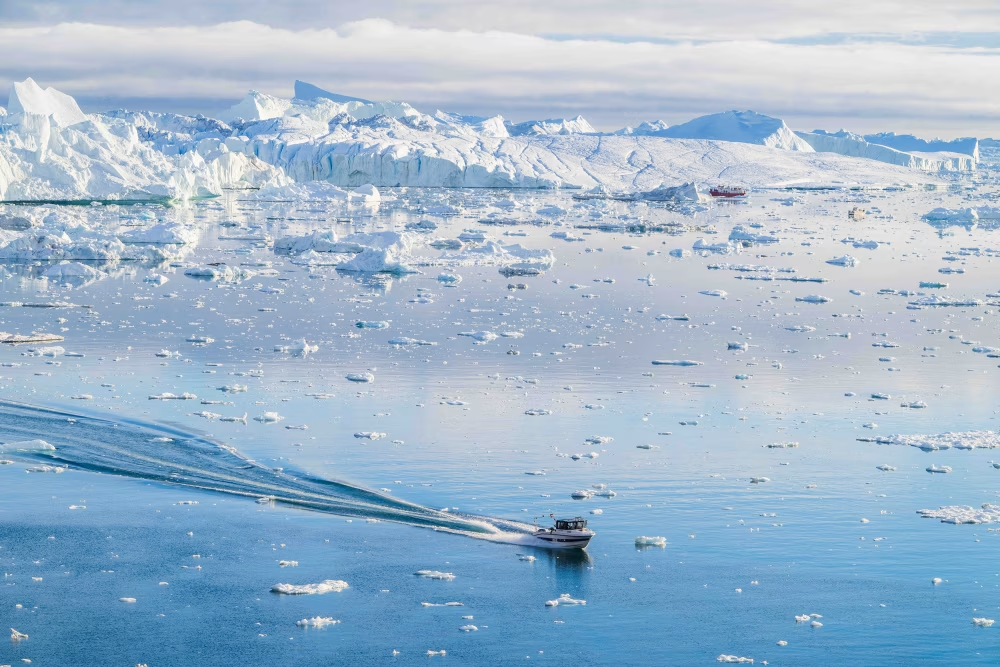
Earth’s two largest ice sheets have lost an estimated 12.5 trillion tons of ice since 1979, adding substantially to rising sea levels and highlighting the accelerating effects of a warming climate, according to a new international scientific study.
Researchers estimate that the amount of ice lost from Greenland and Antarctica is equivalent to nearly 3 quadrillion gallons of water. Spread across the contiguous United States, the lost ice would amount to a layer roughly five feet deep.
The findings, published in Scientific Data, draw on observations from decades of satellite measurements and provide one of the longest assessments yet of changes in the planet’s major ice sheets.
Most Ice Loss Linked to Warmer Ocean Water
Scientists say the majority of the ice loss did not result directly from warmer air temperatures.
Instead, roughly five-sixths of the decline was associated with warmer ocean water interacting with the ice sheets. Warmer seas can melt ice from beneath and along the edges of glaciers, while accelerating the movement of ice toward the ocean.
Eric Rignot, an ice scientist at the University of California, Irvine, and a co-author of the study, said the rapid loss of polar ice is contributing to rising sea levels worldwide.
The researchers estimate that melting from Greenland and Antarctica alone has raised global sea levels by about 3.1 centimeters, or roughly 1.2 inches, since 1979. Other factors, including the expansion of warming seawater and melting glaciers elsewhere, have also contributed to the overall rise in ocean levels.
Even Small Sea-Level Increases Can Have Major Effects
Although an increase of about an inch may appear modest, scientists say its consequences can be significant for coastal communities.
Lead author Ines Otosaka of Northumbria University estimates that every additional centimeter of global sea-level rise can expose another 2 million to 3 million people to flooding at least once a year.
Some individual glaciers are also retreating rapidly. Greenland’s Jakobshavn Glacier, one of the island’s major ice outlets, has recently been retreating at rates of up to about 50 meters per day, according to the researchers.
Satellite Data Reveal a Long-Term Acceleration
The study combines information from 27 satellites and 45 independent surveys to reconstruct changes in the ice sheets over several decades.
Earlier assessments largely focused on the period beginning in the 1990s. By incorporating additional observations from NASA and European satellites, researchers were able to extend the record for Antarctica to 1979 and use much older observations for Greenland.
The data indicate that Greenland and Antarctica were comparatively stable through much of the 1970s, 1980s and early 1990s. Ice losses subsequently increased, with the most pronounced acceleration occurring during the 2010s.
Otosaka said the long-term pattern shows that the ice sheets are losing increasing amounts of mass, particularly through ice flowing directly into the oceans.
Temporary Pause Did Not Reverse the Trend
Researchers observed a slowdown in overall ice loss between 2020 and 2023. However, scientists involved in the study said the temporary change was primarily associated with short-term weather conditions rather than a reversal of the long-term trend.

In Antarctica, unusually heavy snowfall in East Antarctica helped offset substantial losses from the more unstable West Antarctic Ice Sheet.
Rignot described the pause as a temporary variation within a much longer period of increasing ice loss.
The researchers said observations following 2023 indicate that the broader acceleration has resumed.
Scientists Watch for Faster Ice-Sheet Changes
A major concern is the role of so-called dynamic ice loss, in which glaciers rapidly accelerate toward the ocean rather than simply losing ice gradually through surface melting.
Otosaka said these processes can produce abrupt changes and potentially contribute to ice-sheet instability.
David Holland, an ice scientist at New York University who was not involved in the study, said the fact that much of the observed loss is dynamic is particularly significant when considering the possibility of major ice-sheet instability.
He said the study’s use of multiple independent measurement techniques strengthens confidence in its overall findings.
University of Colorado ice scientist Ted Scambos, who also was not involved in the research, described Antarctic ice loss as a major long-term challenge for societies attempting to manage the effects of climate change.
The study’s authors emphasize that the ice sheets are responding to changes in the climate over long periods, meaning that even if global warming were brought under control, some effects on polar ice could continue for decades.
The findings underscore the importance of monitoring Greenland and Antarctica, where changes in ice loss can have consequences far beyond the polar regions through their contribution to global sea-level rise.