











Belarus has released 25 prisoners under an interim agreement with the United States that includes the removal of sanctions against two Belarusian companies, marking another step in Washington’s efforts to secure the release of people detained by the government of President Alexander Lukashenko.
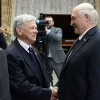
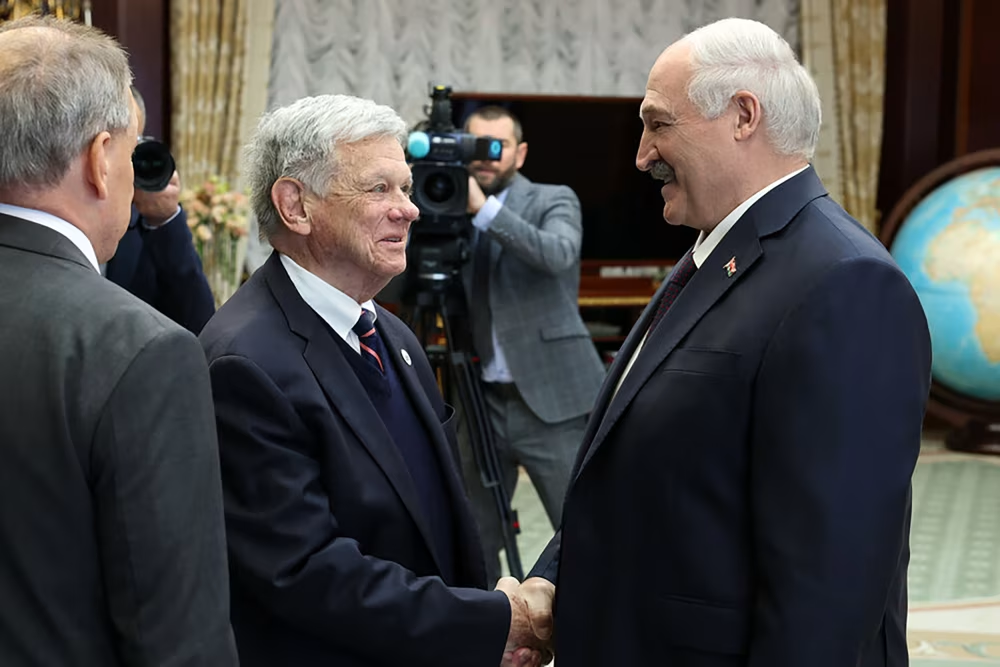
U.S. special envoy John Coale announced the agreement Wednesday after meeting Lukashenko in Minsk. Coale said the United States would lift sanctions on two Belarusian companies as part of the arrangement and that negotiations would continue with the goal of securing additional releases.
The agreement follows months of U.S. diplomacy aimed at persuading Belarus to release political prisoners, journalists, activists and others held by the government. Washington has offered sanctions relief and other measures as incentives in the negotiations.
25 Prisoners Released
Coale said the 25 prisoners had been released as part of what he described as an interim agreement.
Exiled Belarusian opposition leader Sviatlana Tsikhanouskaya said the released individuals had safely reached neighboring Lithuania. Among those freed were journalist Andrei Alyaksandrau, who had been serving a 14-year sentence, and his wife, Iryna Zlobina, who had received a nine-year sentence.
Liudmila Chekina, the former head of independent news organization TUT.BY, was also released. She had been serving a 12-year sentence.
A separate source familiar with the negotiations told Reuters that additional prisoners could be released and remain inside Belarus.
The latest release is considerably smaller than the agreement reached during Coale’s previous visit to Minsk in March, when Belarus agreed to release 250 prisoners.
Washington Removes Sanctions on Two Companies
Under the latest agreement, the United States will remove sanctions against Lakokraska, a Belarusian manufacturer of paints and industrial coatings, and Bellesbumprom, a state-owned company overseeing forestry, pulp and paper industries.
The sanctions against the two businesses had been imposed in different years and were part of broader U.S. restrictions on Belarus.
Coale also said Washington would work with U.S. banks regarding tens of millions of dollars in Belarusian assets that remain frozen. Lukashenko had raised the issue during his meeting with the U.S. envoy.
Coale has indicated that further sanctions relief could accompany additional prisoner releases.
Hundreds Remain Detained
Despite the latest releases, human rights organizations say hundreds of people remain imprisoned in Belarus.
Viasna, a Belarusian human rights organization that is banned by the government, reported that more than 900 political prisoners were still being held at the beginning of the week. A separate Associated Press report put the figure at 887.
The detainees include opposition activists, journalists, lawyers and human rights campaigners. Common charges cited by Belarusian authorities include alleged extremist activity, incitement and offenses involving state institutions.

Lukashenko rejects the characterization of those detainees as political prisoners. He has also denied claims that his government is simply replacing released prisoners with newly detained opponents.
U.S. Seeks Further Releases
Coale said Washington plans to continue negotiations and hopes to achieve a much larger number of releases in the coming months.
The envoy told Reuters he expects to return to Belarus in about a month and hopes that hundreds more prisoners could be freed during the next round of talks.
The U.S.-Belarus negotiations have already resulted in the release of hundreds of detainees since the middle of 2025. Among those previously freed was Nobel Peace Prize laureate Ales Bialiatski.
Tsikhanouskaya welcomed the latest releases but emphasized that many people remain behind bars.
The continuing arrests have also drawn international criticism. A United Nations panel said this week that Belarus’ judicial system has been used systematically to suppress critics of Lukashenko’s government, citing allegations of arbitrary arrests, torture, inadequate legal protections and closed trials.
Diplomacy Continues Despite Wider Tensions
Lukashenko, who has governed Belarus for more than three decades, remains closely aligned with Russian President Vladimir Putin. Belarus has faced extensive Western sanctions over its treatment of political opponents and its support for Russia following the invasion of Ukraine.
The prisoner-release negotiations have nevertheless opened a channel of direct communication between Washington and Minsk.
For the United States, the talks offer a way to seek the release of detainees while negotiating limited sanctions relief. For Belarus, the process has provided opportunities to pursue the removal of economic restrictions and address frozen assets.
The latest agreement leaves both sides with unresolved issues, but Coale said negotiations would continue in an effort to secure further releases and expand U.S.-Belarus engagement.