
















Iran’s leadership has long relied on force to silence dissent, but the scale and intensity of the latest crackdown on protesters suggest the country may be entering a new and far more dangerous phase, according to analysts and human rights groups.
Protests that erupted last month over soaring prices and economic hardship have spread rapidly across Iran, reaching every one of the country’s 31 provinces. What began as localized demonstrations has turned into a nationwide uprising met with extraordinary violence. Human rights monitors estimate that at least 2,500 people have been killed and tens of thousands detained as security forces attempt to reassert control.
Observers say the breadth of the unrest—spanning major cities and remote towns alike—has driven the government to respond with unprecedented force.
“This is not a routine suppression,” said Clément Therme, a researcher specializing in Iranian politics. “The protests are geographically widespread and socially diverse, which the authorities see as an existential threat.”
Iran’s judiciary has publicly hinted at fast-tracked trials and executions, a tactic the state has used before to instill fear. Human rights organizations estimate that roughly 19,000 people have been arrested, though verifying numbers remains difficult due to internet blackouts and tight restrictions on journalists.
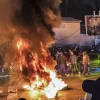
Despite the information blackout, fragments of evidence have emerged. Videos verified by international media appear to show piles of bodies near improvised morgues outside Tehran, as families search desperately for missing relatives. Other footage shows security forces firing automatic weapons into crowds, the sound of gunfire echoing through residential streets.
Iranians who have managed to make calls abroad describe neighborhoods under heavy security presence, drone surveillance hovering overhead, and a sense of living under siege. Shops reopen sporadically, often under orders to close early, while foot traffic remains thin. Diaspora-based news outlets report what witnesses describe as “war-like conditions,” with sustained clashes between protesters and state forces.
According to analysts, this escalation reflects a regime that has steadily expanded both its capacity and willingness to use lethal force. Rouzbeh Parsi, a scholar of Iranian foreign and domestic policy, says the government is reacting to a convergence of internal fury and external pressure.
“The leadership feels surrounded—by sanctions, by international isolation, and by deep resentment at home,” he said. “That combination makes restraint unlikely.”
Iran’s violent response follows a grim historical pattern. After the 1979 revolution toppled Shah Mohammad Reza Pahlavi, hopes for democratic reform quickly gave way to an authoritarian theocracy under Ayatollah Ruhollah Khomeini. In the 1980s, the new regime executed or disappeared thousands of political opponents, culminating in mass prison killings in 1988.
Later waves of unrest were met with similar brutality. The 2009 Green Movement, sparked by allegations of election fraud, left dozens dead. Protests over economic conditions in 2017, 2018, and 2019 also ended violently, with hundreds killed. In 2022, nationwide demonstrations erupted after the death of Mahsa Amini, a young woman detained by morality police, resulting in hundreds more deaths and mass arrests.
What distinguishes the current crackdown, experts say, is its scale and its apparent coordination. Surveillance drones, rapid troop deployments, and live ammunition appear to be used systematically rather than sporadically.
Human rights advocates note parallels with Iran’s role in Syria, where Tehran supported President Bashar al-Assad’s violent suppression of protests in 2011. That experience, they argue, has informed Tehran’s current tactics at home.
“Iranian security forces have learned from conflicts beyond their borders,” said Hadi Ghaemi, director of a U.S.-based Iranian human rights group. “They are applying lessons from Syria—swift, overwhelming violence to crush a nationwide movement before it can consolidate.”
For now, the government appears determined to maintain power at any cost. But analysts caution that such extreme repression carries risks. The depth of public anger, combined with the visibility of mass killings—even in fragments—may harden resistance rather than extinguish it.

Iran has survived unrest before. Whether it can withstand the consequences of its most violent crackdown yet remains an open and ominous question.