













SYDNEY — A deadly attack on a Hanukkah gathering near Bondi Beach has left Australia’s Jewish community grappling with grief, anger, and deep uncertainty about its future, as questions mount over whether authorities failed to act on warnings about rising antisemitic threats.
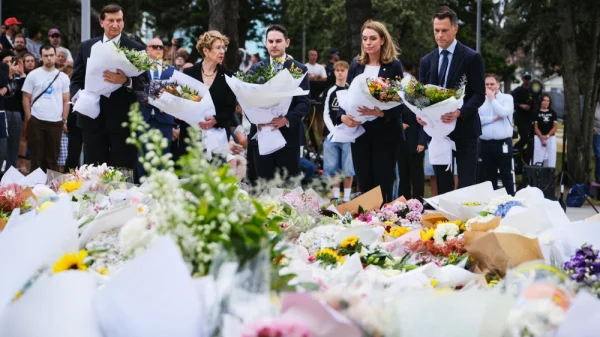
The Dec. 14 attack, which killed 15 people, has been described by community leaders as a turning point for a neighborhood long regarded as a center of Jewish life in Sydney. Vigils and memorials have drawn thousands to Bondi Pavilion in recent days, where flowers and candles now mark a place many say will never feel the same again.
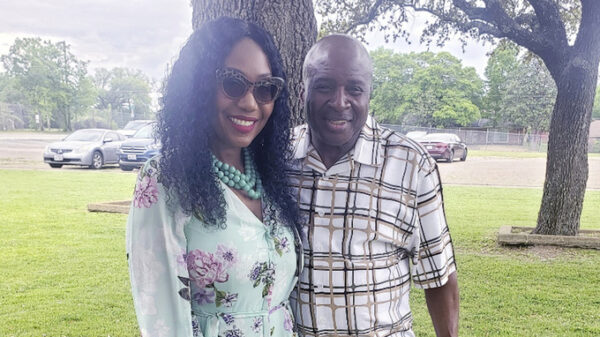
For residents like Linda Royal, whose parents fled Europe during World War II and settled in Bondi after arriving in Australia as refugees, the tragedy has reopened generational wounds. She said the area had historically offered safety and belonging for Jewish migrants, including Holocaust survivors and later arrivals from the former Soviet Union.
“That sense of security has been shattered,” Royal said. “This place is now tied forever to another Jewish tragedy.”
Suspects and Investigation
Authorities have identified the suspects as a father and son, Sajid Akram, 50, and Naveed Akram, 24. Police said the elder Akram was killed at the scene, while his son faces dozens of charges, including terrorism and multiple counts of murder, after regaining consciousness in hospital.
Investigators allege the pair were influenced by extremist ideology linked to the Islamic State group. Police reported finding homemade ISIS flags in the younger suspect’s vehicle, and while the group has not formally claimed responsibility, it has praised the attack in its propaganda.
Community Anger and Government Scrutiny
Beyond mourning, many Jewish leaders say the attack represents a failure of prevention. Alex Ryvchin, co-chief executive of the Executive Council of Australian Jewry, said the community had repeatedly warned federal and state governments about escalating threats, including harassment, vandalism, and arson attacks targeting synagogues.
“There was a clear progression of violence,” Ryvchin said. “Many believe this could have been stopped if those warnings had been taken seriously.”
Criticism has focused on what some see as insufficient policing and delayed responses to extremist rhetoric. Calls are growing for a Royal Commission — a major public inquiry — to examine how the attack occurred and whether security agencies missed opportunities to intervene.
Political Response and Debate
Prime Minister Anthony Albanese has apologized to the Jewish community and pledged action, saying his government would strengthen measures addressing hate speech, gun control, and extremist symbols. New South Wales officials are debating tougher firearm laws and restrictions on displays linked to terrorist organizations, while also considering limits on certain protests.
However, the proposed measures have sparked controversy. Civil liberties advocates and some Jewish groups argue the reforms are rushed and risk infringing on constitutional rights. Progressive Jewish organizations have also pushed back against claims that pro-Palestinian demonstrations fueled the violence, saying there is no evidence linking those protests to the attackers.
A Community Changed
Australia is home to a diverse Jewish population, many of whom say they are now reassessing their sense of safety in public spaces. Community members describe increased fear around religious celebrations and a growing need for visible security at events that were once routine.
Whether or not a formal inquiry is launched, many in Bondi say the psychological impact will endure. As memorials continue and investigations unfold, residents are left balancing remembrance with a pressing question: how to ensure that a community built by generations of refugees can once again feel secure in the place they call home.